
How to Avoid Sedentary Behavior- 3-Minutes at a Time
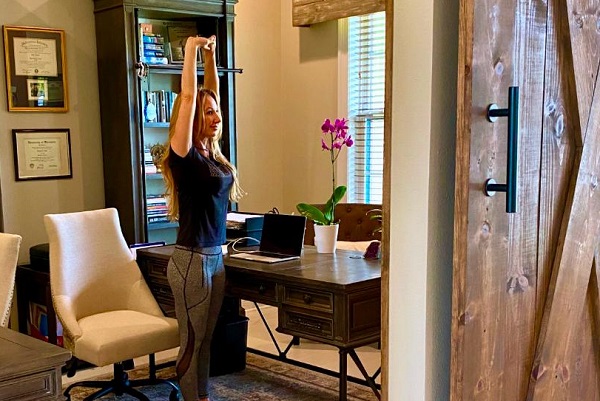
Stop sitting still and do these 8 activities throughout the workday — 3 minutes at a time
Over the course of the pandemic, many people who previously commuted to office spaces and job sites joined the at-home workforce. Unfortunately, that additional time at home easily equates to more sedentary time.
Whether you work from home or not, if your normal daily schedule has you sitting still for hours at a time, it’s important to make an effort to move throughout your day to avoid the negative health implications of being sedentary, such as an increased risk for cancer. In fact, breaking up long bouts of sitting still with just a little exercise can boost your overall health and fitness.
What if, over the course of an eight-hour day, you got up and moved for three minutes every hour?
That’s 24 minutes of exercise daily. Add another 10 minutes of walking or stair climbing before or after work, and you’d be at 34 minutes daily, or 170 minutes per five-day workweek. That’s well over the weekly threshold of 150 minutes, or two-and-a-half hours, recommended by the World Health Organization — without ever setting foot in a gym.
Read on for a practical plan to integrate three-minute movement intervals into an otherwise sedentary eight-hour workday.
1. Get up. Sit down. Repeat
It’s important to get up from your chair at least once an hour. The simplest way to start moving is to make the act of getting up out of your chair and sitting back down into an exercise.
Coaches and trainers call this a box squat. From standing in front of your chair, slowly sit down, making contact with the seat without putting your full weight on it. Then drive through your feet, legs and hips to stand back up. Repeat this movement, at your own pace, for the full three minutes.
If you’re feeling up to it, after a minute or two, you can progress to body-weight squats without the chair. If your chair has wheels, be sure to lock them before performing box squats.
2. Get your heart pumping
Your body is designed to move through three planes of motion: sagittal (front to back), transverse (rotating) and frontal (side to side) so it’s important to exercise in all of them. Think about it: While sitting at a desk, you’re not doing very much side-to-side movement. Everything tends to be right in front of you.
Jumping jacks are a simple yet effective side-to-side movement that gets your heart pumping. That said, I’m not recommending you hop out of your chair every hour and immediately start doing jumping jacks.
To avoid the potential for injury after prolonged sitting, first prepare your body for any type of higher-impact activity. Prep time counts toward your three minutes, so spend a minute doing some side bends, lateral lunges and jogging in place before moving into jumping jacks. If jumping is too high-impact for you, modify with alternating side steps rather than jumps.
3. Move your hands to relieve tension
Ever consider that the tension in your hands from all that typing might be contributing to the tension in your shoulders?
Muscles work in chains, so tension can creep up and down your body. When you’re tight or immobile in one area, other muscles have to compensate to help you move. Those muscles then become understandably overworked and tight, setting off a chain reaction of muscular compensation and chronic tension.
To perform hand exercises, focus on one hand at a time. Rest the elbow of the hand you’re exercising on your desk to stabilize it. Make a tight fist and then open your hand and spread your fingers as wide as possible. Repeat five times.
Then make a fist and slowly circle your wrist in one direction five times. Repeat in the opposite direction. Open your hand and use your opposite hand to gently press your fingers back to stretch the inside of your wrist and hand. Hold for three breaths. Repeat pressing your hand forward to stretch the back of your hand and wrist.
Then focus on your fingers. Use your opposite hand to hold and stabilize your wrist as you stick your thumb out and make three circles in one direction and then the other. Repeat this action to the best of your ability with each finger. Repeat all the exercises with your other hand.
Finish by standing up, interlacing your fingers and stretching your arms overhead with your palms facing up. Hold for a few breaths, then repeat with your hands interlaced out in front of you and then behind
you. You may find you struggle with some fingers more than others and that it’s more difficult with your nondominant hand. That’s OK. Do the best you can and you will see improvement over time.
4. Move your feet, too
The same type of muscular chain reaction from tension can happen with your feet. Spending just few minutes a day actively moving your feet and ankles can have a dramatic impact on how you feel throughout your body.
You’ll need to take your shoes off and, if possible, your socks. However, if you work in an actual office, be considerate of co-workers who might not want to see (or smell) your feet!
Cross one leg over the other, focusing on the top foot. Point your toes forward and down, like a ballerina, then flex your foot back to point your toes up, spreading them out as wide as you can. Repeat 10 times. Then slowly circle your ankle in one direction 10 times. Repeat in the opposite direction. Spend a moment focusing on your toes, seeing if you can move your big toe, little toe and other toes independently. Repeat the exercises with your other foot.
Finally, stand up and do 10 repetitions of alternating, shifting your weight evenly to the outsides of your feet, trying to lift the inside edges, then shifting your weight to the insides of your feet while attempting to lift the outside edges. Then do 10 slow, controlled calf raises, lifting your heels and pushing your weight onto the balls of your feet then lowering your heels back down. Place one hand on a chair or wall for balance.
5. Elevate your energy and mood with a dance break
It’s common for both mental and physical energy to wane in the afternoon after lunch. Instead of reaching for that extra cup of coffee or energy drink, why not take an invigorating dance break to one of your favorite beats? Most songs average three to four minutes, so you’ll more than cover your hourly movement quota. Simply turn on a feel-good jam and let your body move to the music.
6. Practice standing meetings with movement
Now that everyone has discovered Zoom, it’s rare to have a workday that doesn’t include at least one virtual meeting. During those meetings, position your screen on a higher surface, like a kitchen island, so you can comfortably stand for your meeting. While standing, spend a few minutes softly marching in place or shifting your weight from one foot to the other to work on your balance.
If you have regular daily meetings with folks you know well, consider asking if they’d like to institute a movement break. Think of it like the seventh inning stretch at a baseball game. Meeting participants could take turns leading the stretch.
7. Build strength with good old-fashioned pushups
There’s a reason the pushup has remained a staple exercise since its origination more than a century ago. You won’t find many other singular exercises that build both upper body and core strength as well as a pushup. Although challenging, there are easy ways to modify it to ensure some variation of pushup is accessible for most anyone.
Traditional pushups are done on the floor from a plank position with your legs straight behind you and wrists under your shoulders. You bend your arms and stabilize your core to lower your body almost to the floor and then straighten your arms to push back up.
To cover three minutes, do as many pushups as you can with good form for 20 seconds and then rest for 10 seconds. Repeat through six rounds. To modify, you can put your knees on the floor or elevate your hands on a stair or chair seat. You can also do plank holds instead.
8. Take a few minutes to fix your posture and prevent pain
Although you’ve been moving every hour, at the end of the workday, it’s helpful to spend a few minutes proactively recovering from sitting in front of a screen. Focus on movements that open up and unwind that slumped-over posture we tend to take in front of our computers and when looking down at our phones. Do gentle chest and back stretches and twists.
Remember the planes of motion I mentioned earlier? Twisting takes place in the transverse plane, another plane we don’t often move in at our desks. Check out the stretches and twists in this article on movements to offset too much sitting for ideas.
Don’t forget to walk
Walking is one of the most accessible, total-body, fat-burning exercises available to humankind. Every day, try to take at least a 10-minute walk — ideally, outside. If weather or environment are obstacles to walking, consider this simple 11-minute at-home workout as an alternative.
With 24 minutes of movement to break up your workday, adding even a six-minute walk will get you to a nice, round 30-minute mark for daily exercise. After only a week of practicing this plan, you should definitely notice a boost in your overall health and fitness.
Contributor: Dana Santas, CNN Health, .
Whether you work from home or not, if your normal daily schedule has you sitting still for hours at a time, it’s important to make an effort to move throughout your day to avoid the negative health implications of being sedentary, such as an increased risk for cancer. In fact, breaking up long bouts of sitting still with just a little exercise can boost your overall health and fitness.
What if, over the course of an eight-hour day, you got up and moved for three minutes every hour?
That’s 24 minutes of exercise daily. Add another 10 minutes of walking or stair climbing before or after work, and you’d be at 34 minutes daily, or 170 minutes per five-day workweek. That’s well over the weekly threshold of 150 minutes, or two-and-a-half hours, recommended by the World Health Organization — without ever setting foot in a gym.
Read on for a practical plan to integrate three-minute movement intervals into an otherwise sedentary eight-hour workday.
1. Get up. Sit down. Repeat
It’s important to get up from your chair at least once an hour. The simplest way to start moving is to make the act of getting up out of your chair and sitting back down into an exercise.
Coaches and trainers call this a box squat. From standing in front of your chair, slowly sit down, making contact with the seat without putting your full weight on it. Then drive through your feet, legs and hips to stand back up. Repeat this movement, at your own pace, for the full three minutes.
If you’re feeling up to it, after a minute or two, you can progress to body-weight squats without the chair. If your chair has wheels, be sure to lock them before performing box squats.
2. Get your heart pumping
Your body is designed to move through three planes of motion: sagittal (front to back), transverse (rotating) and frontal (side to side) so it’s important to exercise in all of them. Think about it: While sitting at a desk, you’re not doing very much side-to-side movement. Everything tends to be right in front of you.
Jumping jacks are a simple yet effective side-to-side movement that gets your heart pumping. That said, I’m not recommending you hop out of your chair every hour and immediately start doing jumping jacks.
To avoid the potential for injury after prolonged sitting, first prepare your body for any type of higher-impact activity. Prep time counts toward your three minutes, so spend a minute doing some side bends, lateral lunges and jogging in place before moving into jumping jacks. If jumping is too high-impact for you, modify with alternating side steps rather than jumps.
3. Move your hands to relieve tension
Ever consider that the tension in your hands from all that typing might be contributing to the tension in your shoulders?
Muscles work in chains, so tension can creep up and down your body. When you’re tight or immobile in one area, other muscles have to compensate to help you move. Those muscles then become understandably overworked and tight, setting off a chain reaction of muscular compensation and chronic tension.
To perform hand exercises, focus on one hand at a time. Rest the elbow of the hand you’re exercising on your desk to stabilize it. Make a tight fist and then open your hand and spread your fingers as wide as possible. Repeat five times.
Then make a fist and slowly circle your wrist in one direction five times. Repeat in the opposite direction. Open your hand and use your opposite hand to gently press your fingers back to stretch the inside of your wrist and hand. Hold for three breaths. Repeat pressing your hand forward to stretch the back of your hand and wrist.
Then focus on your fingers. Use your opposite hand to hold and stabilize your wrist as you stick your thumb out and make three circles in one direction and then the other. Repeat this action to the best of your ability with each finger. Repeat all the exercises with your other hand.
Finish by standing up, interlacing your fingers and stretching your arms overhead with your palms facing up. Hold for a few breaths, then repeat with your hands interlaced out in front of you and then behind
you. You may find you struggle with some fingers more than others and that it’s more difficult with your nondominant hand. That’s OK. Do the best you can and you will see improvement over time.
4. Move your feet, too
The same type of muscular chain reaction from tension can happen with your feet. Spending just few minutes a day actively moving your feet and ankles can have a dramatic impact on how you feel throughout your body.
You’ll need to take your shoes off and, if possible, your socks. However, if you work in an actual office, be considerate of co-workers who might not want to see (or smell) your feet!
Cross one leg over the other, focusing on the top foot. Point your toes forward and down, like a ballerina, then flex your foot back to point your toes up, spreading them out as wide as you can. Repeat 10 times. Then slowly circle your ankle in one direction 10 times. Repeat in the opposite direction. Spend a moment focusing on your toes, seeing if you can move your big toe, little toe and other toes independently. Repeat the exercises with your other foot.
Finally, stand up and do 10 repetitions of alternating, shifting your weight evenly to the outsides of your feet, trying to lift the inside edges, then shifting your weight to the insides of your feet while attempting to lift the outside edges. Then do 10 slow, controlled calf raises, lifting your heels and pushing your weight onto the balls of your feet then lowering your heels back down. Place one hand on a chair or wall for balance.
5. Elevate your energy and mood with a dance break
It’s common for both mental and physical energy to wane in the afternoon after lunch. Instead of reaching for that extra cup of coffee or energy drink, why not take an invigorating dance break to one of your favorite beats? Most songs average three to four minutes, so you’ll more than cover your hourly movement quota. Simply turn on a feel-good jam and let your body move to the music.
6. Practice standing meetings with movement
Now that everyone has discovered Zoom, it’s rare to have a workday that doesn’t include at least one virtual meeting. During those meetings, position your screen on a higher surface, like a kitchen island, so you can comfortably stand for your meeting. While standing, spend a few minutes softly marching in place or shifting your weight from one foot to the other to work on your balance.
If you have regular daily meetings with folks you know well, consider asking if they’d like to institute a movement break. Think of it like the seventh inning stretch at a baseball game. Meeting participants could take turns leading the stretch.
7. Build strength with good old-fashioned pushups
There’s a reason the pushup has remained a staple exercise since its origination more than a century ago. You won’t find many other singular exercises that build both upper body and core strength as well as a pushup. Although challenging, there are easy ways to modify it to ensure some variation of pushup is accessible for most anyone.
Traditional pushups are done on the floor from a plank position with your legs straight behind you and wrists under your shoulders. You bend your arms and stabilize your core to lower your body almost to the floor and then straighten your arms to push back up.
To cover three minutes, do as many pushups as you can with good form for 20 seconds and then rest for 10 seconds. Repeat through six rounds. To modify, you can put your knees on the floor or elevate your hands on a stair or chair seat. You can also do plank holds instead.
8. Take a few minutes to fix your posture and prevent pain
Although you’ve been moving every hour, at the end of the workday, it’s helpful to spend a few minutes proactively recovering from sitting in front of a screen. Focus on movements that open up and unwind that slumped-over posture we tend to take in front of our computers and when looking down at our phones. Do gentle chest and back stretches and twists.
Remember the planes of motion I mentioned earlier? Twisting takes place in the transverse plane, another plane we don’t often move in at our desks. Check out the stretches and twists in this article on movements to offset too much sitting for ideas.
Don’t forget to walk
Walking is one of the most accessible, total-body, fat-burning exercises available to humankind. Every day, try to take at least a 10-minute walk — ideally, outside. If weather or environment are obstacles to walking, consider this simple 11-minute at-home workout as an alternative.
With 24 minutes of movement to break up your workday, adding even a six-minute walk will get you to a nice, round 30-minute mark for daily exercise. After only a week of practicing this plan, you should definitely notice a boost in your overall health and fitness.
Contributor: Dana Santas, CNN Health, .